

 Grains & Pulses
 Organic Produce
 Spices & Condiments
 Fresh Herbs

 Fresh Fruits
 Fresh Vegetables
 Exotic Produce
 Seasonal Specials

 Groundnut Seeds
 Mustard Seeds
 Sesame Seeds
 Sunflower Seeds

 Fresh Fish
 Frozen Fish
 Crab & Lobster
 Prawns & Shrimps

 Bath & Body
 Skincare
 Haircare
 Oral Care

 Flavored Honey
 Honey Syrups
 Organic Honey
 Raw Honey

 Cornflakes
 Millet Mixes
 Oats & Muesli
 Granola

 Mini Tractors
 Harvesting Tools
 Power Tillers
 Sprayers & Pumps

 Chemical Fertilizers
 Pesticides
 Organic Fertilizers
 Herbicides

 Farm Tools
 Irrigation Equipment
 Threshers

 Packaging Machines
 Cold Storage Units
 Food Processing Machines
 Grinding & Milling Machines

 Baby Food
 Baby Skincare
 Diapers & Wipes
 Toys & Accessories

 Cattle Feed
 Fish Feed
 Pet Food
 Poultry Feed

 Frozen Chicken
 Ham & Bacon
 Meat Snacks
 Sausages

 Bakery Products
 Beverages (Juices, Soft Drinks)
 Packaged Snacks
 Ready-to-Eat Foods

 Biofuels
 Energy Storage Batteries
 Solar Panels
 Wind Energy Equipment


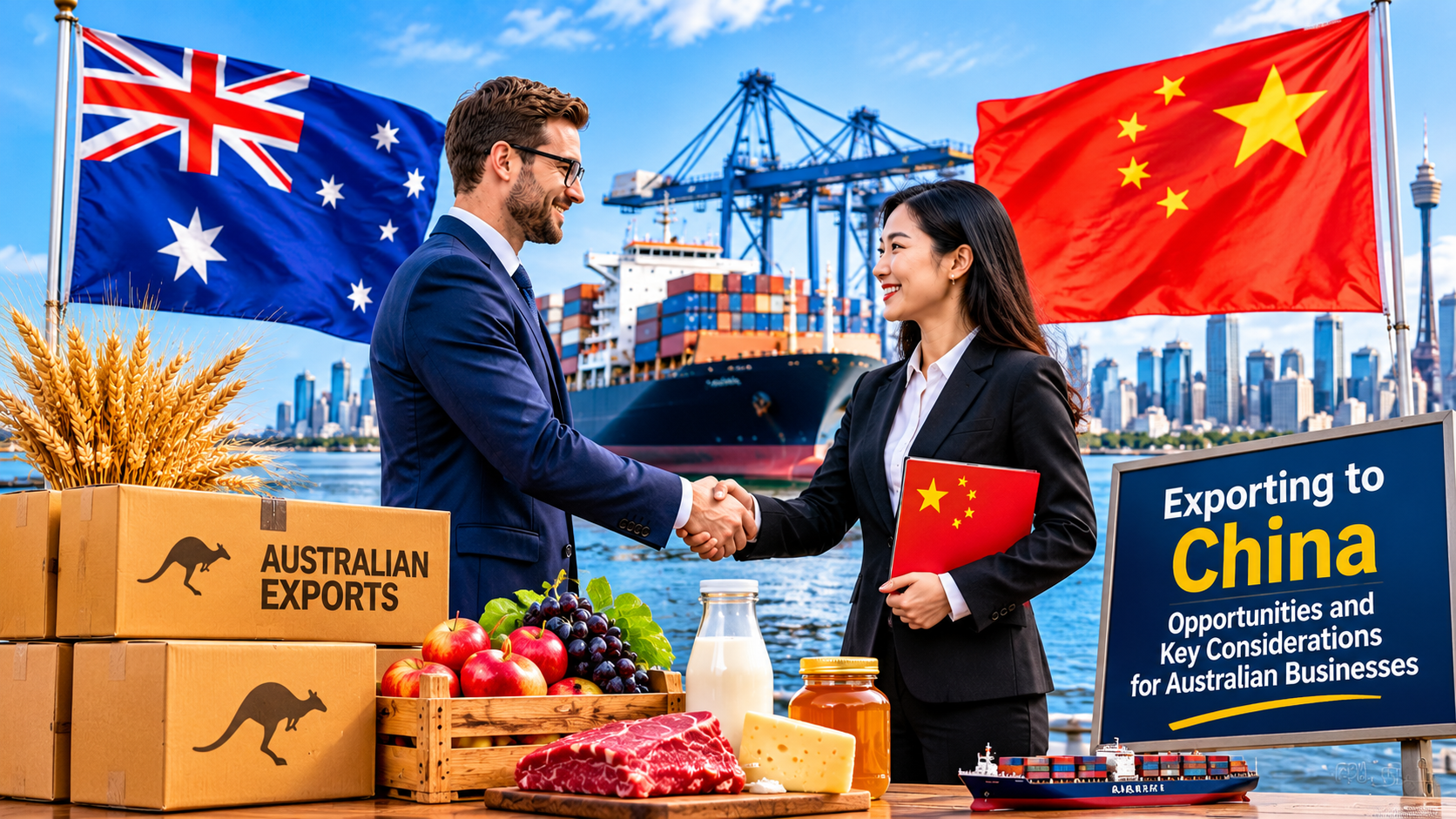
Exporting to China: Opportunities and Key Considerations for Australian Businesses

7 Easy Steps for Exporting to China from Australia
Exporting to China: Opportunities and Key Considerations for Australian Businesses
Introduction
Exporting to China from Australia offers significant opportunities for Australian businesses looking to expand into international markets. China is one of Australia’s most important trading partners, with strong commercial relationships across agriculture, food, natural resources, manufacturing, education and professional services.
Australian manufacturers, farmers, wholesalers, suppliers and producers can explore the Chinese market to reach new customers, develop business partnerships and increase international sales. However, entering China requires careful preparation, market research and a clear understanding of import regulations.
Businesses must consider product suitability, pricing, documentation, customs procedures, shipping arrangements and potential buyers before starting an export operation.
Whether a company is an established exporter or entering international trade for the first time, understanding these factors can make the process easier to manage.
This guide explains the key opportunities, practical steps and important considerations for Australian businesses interested in exporting products to China.
1. Why China Is an Important Market for Australian Exporters
China is an important destination for Australian goods and services. Its large economy, diverse industries and established trade relationships create opportunities for businesses across many sectors.
According to the Australian Department of Foreign Affairs and Trade (DFAT), two-way goods and services trade between Australia and China reached approximately AUD $326 billion in 2025. Australian exports to China accounted for approximately AUD $196 billion of that trade. DFAT
There are several reasons Australian businesses may consider entering the Chinese market.
Large commercial market: China has a substantial consumer and industrial market with demand across a variety of product categories.
Established trade relationships: Australia and China have a long history of commercial cooperation, supported by trade agreements and business connections.
Product opportunities: Australian suppliers can investigate opportunities in agriculture, food, seafood, dairy, natural resources and manufactured products.
Business development: Exporting can help companies diversify their customer base and establish relationships with international distributors and wholesalers.
However, market opportunities vary by industry. Businesses should research demand and competition before investing in export activities.
2. Popular Australian Products for Export to China
Australian businesses operate across many industries, providing a wide range of products and services that may be suitable for the Chinese market.
The following categories can be starting points for export research.
Agricultural Products
Australian agricultural businesses produce grains, pulses, livestock products, wool and other commodities. These products may create opportunities with Chinese importers and processing companies.
Exporters must investigate applicable agricultural market-access conditions, quarantine requirements and product specifications before accepting orders.
Food and Beverages
Australian food producers may explore opportunities in meat, seafood, dairy, processed foods, beverages and other premium food categories.
Food exporters should pay particular attention to food safety, product registration, packaging and Chinese labelling requirements.
Natural Resources
Australia has significant natural resource industries. Products such as iron ore, mineral resources and other commodities are important components of Australia-China trade.
Businesses entering these industries may need substantial production capacity, specialised logistics and established commercial contracts.
Health and Personal Care Products
Some Australian manufacturers may investigate opportunities involving cosmetics, personal care and selected health-related products.
These categories can involve specific Chinese registration, safety and marketing requirements. Businesses should verify whether their products require regulatory approval before selling them.
Education and Professional Services
Export opportunities are not limited to physical products. Australian education providers, consultants and professional service businesses can also investigate opportunities in China’s services market.
Selecting the right product or service requires understanding local demand, regulatory conditions and customer preferences.
3. Conduct Market Research Before Exporting
Market research is one of the most important steps when exporting to China from Australia.
Businesses should identify the customers they want to reach and understand how their products will compete in the local market.
Start by researching the following areas:
- Demand for the selected product.
- Local competitors and alternative suppliers.
- Wholesale and retail pricing.
- Customer purchasing preferences.
- Import duties and taxes.
- Product registration and certification.
- Distribution and transportation costs.
- Potential importers and distributors.
It is also important to understand the differences between China’s business regions. Customer preferences, distribution networks and commercial opportunities may vary between major cities and provinces.
Australian exporters can use government trade information, industry associations, trade exhibitions and professional networks to collect relevant market insights.
Companies should also speak with potential buyers to understand their product specifications, purchasing volumes and supplier requirements.
A well-researched market entry strategy can help businesses avoid unnecessary investment and identify more suitable commercial opportunities.
4. Understand the China-Australia Free Trade Agreement (ChAFTA)
The China-Australia Free Trade Agreement, commonly known as ChAFTA, is an important consideration for Australian exporters.
ChAFTA entered into force on 20 December 2015 and provides preferential trade arrangements for eligible Australian goods and services entering China.
The agreement has helped improve market access and reduce tariffs on a range of Australian export products.
DFAT states that by 1 January 2029, 99 per cent of Australia’s goods exports to China are scheduled to enter duty-free under the agreement. DFAT
However, not every product automatically qualifies for preferential tariff treatment.
Before claiming ChAFTA benefits, exporters should:
- Identify the correct Harmonised System (HS) code for their products.
- Check the applicable Chinese tariff rate.
- Review the relevant Rules of Origin.
- Confirm whether the goods qualify as originating goods.
- Prepare the appropriate Certificate of Origin or Declaration of Origin where required.
These steps are important because tariff benefits depend on product classification, origin requirements and supporting documentation.
Businesses can use the Australian Government’s official ChAFTA guidance to investigate tariff treatment and eligibility. DFAT+1
5. Understand Chinese Import Regulations and Product Requirements
Understanding Chinese import regulations is essential before exporting Australian products.
China has specific rules covering product safety, quality, packaging, labelling, customs documentation and registration.
Requirements vary depending on the product category.
For example, agricultural goods, meat, dairy, seafood and processed food can involve additional registration, inspection, certification and biosecurity requirements.
Australian food exporters should pay particular attention to China’s General Administration of Customs (GACC) and its China Import Food Enterprise Registration (CIFER) system.
The Australian Department of Agriculture, Fisheries and Forestry (DAFF) provides guidance about establishment and food-product registration for Australian businesses exporting food to China.
China’s Decree 280 took effect from 1 June 2026, and DAFF’s relevant guidance pages indicate that information is under review. Therefore, businesses should check the latest official instructions before applying or shipping products. DAFF+1
For non-food products, exporters should investigate applicable safety standards, certification and product-specific import rules.
It is advisable to confirm requirements with the Chinese importer and relevant authorities before finalising an order.
6. Find Reliable Chinese Buyers and Importers
Finding the right buyer is essential for building a successful export business.
Australian suppliers can explore different channels to connect with potential Chinese importers, wholesalers, distributors and retailers.
Online B2B Marketplaces
Business-to-business marketplaces allow suppliers to showcase product information, receive enquiries and communicate with overseas buyers.
A professional online product listing should include photographs, descriptions, specifications, available quantities and contact details.
Trade Exhibitions and Business Events
Trade exhibitions provide opportunities to meet potential importers, distributors and industry representatives.
Australian companies can use these events to introduce their products and learn more about the Chinese market.
Direct Business Outreach
Businesses can research potential importers and contact them directly with company profiles, product catalogues and wholesale quotations.
Industry Networks
Trade associations and business organisations may help exporters understand industry conditions and develop professional connections.
Before accepting orders, Australian businesses should verify buyer information and review the potential customer’s commercial background.
Checking business credentials, payment history and distribution capabilities can reduce transaction risks.
7. Calculate Export Pricing and Wholesale Costs
Pricing plays an important role in international trade.
Australian exporters should calculate the complete cost of supplying products to China rather than focusing only on the manufacturing or wholesale price.
Important cost factors include:
- Manufacturing or purchasing costs.
- Packaging and labelling.
- Warehouse expenses.
- Domestic transportation.
- International freight.
- Cargo insurance.
- Customs clearance.
- Applicable duties and taxes.
- Distributor commissions.
- Currency exchange costs.
Exporters should also consider how their pricing compares with competitors in China.
A competitive wholesale quotation should clearly state the product description, quantities, unit price, minimum order quantity, payment terms and delivery arrangements.
Understanding Incoterms is also useful because these international commercial terms explain the responsibilities of buyers and sellers for delivery, transportation costs and risk.
Businesses should make sure that quotations are accurate and that they understand all relevant charges before agreeing to an order.
8. Plan Shipping and International Logistics
Shipping is an important consideration when exporting to China from Australia.
Businesses should choose transportation arrangements based on product type, shipment size, delivery requirements and budget.
Sea Freight
Sea freight is commonly considered for large commercial shipments and heavy products. It may provide a cost-effective solution for businesses sending substantial quantities.
Air Freight
Air freight may be appropriate for urgent shipments, high-value goods and products requiring faster delivery.
Specialised Transportation
Some products require additional care during transportation.
Perishable food, seafood and temperature-sensitive products may require cold-chain facilities and specialised cargo handling.
Before selecting a logistics provider, exporters should compare:
- Freight charges.
- Shipping schedules.
- Transit times.
- Insurance coverage.
- Packaging requirements.
- Destination port charges.
- Customs clearance arrangements.
- Warehouse and storage services.
Businesses should also prepare for possible changes in shipping schedules and international freight costs.
Working with an experienced freight forwarder can help exporters coordinate transportation and documentation more efficiently.
9. Prepare Export Documentation
Accurate documentation is necessary for international shipments.
Depending on the product, shipment and destination requirements, Australian exporters may need several documents.
Commercial Invoice: Contains product descriptions, quantities, prices, buyer information and transaction details.
Packing List: Shows the contents, packaging information, weights and quantities of the shipment.
Bill of Lading or Air Waybill: Provides transportation and shipment information.
Certificate of Origin: May be required to support product-origin claims and preferential tariff applications under ChAFTA.
Export Permits: Certain controlled products require approval before leaving Australia.
Product Certificates: Particular food, agricultural or manufactured goods may require additional certificates or inspections.
Insurance Documents: May be needed to show that the shipment has appropriate cargo insurance coverage.
The Australian Border Force requires exported goods to be reported through an Export Declaration or an applicable exemption code.
Generally, an Export Declaration is required for goods valued above AUD $2,000, goods requiring an export permit regardless of value and certain other controlled goods. Businesses should check the specific rules for their shipments. Australian Border Force Website
Exporters should ensure that the information across invoices, packing lists and shipping documents is accurate and consistent.
10. Build Strong Business Relationships in China
International trade depends on reliable communication and professional business relationships.
Australian exporters should take time to understand their customers’ requirements and maintain regular communication.
Providing accurate product information, competitive quotations and realistic delivery schedules can help build confidence.
Businesses should also:
- Respond promptly to buyer enquiries.
- Maintain consistent product quality.
- Confirm orders in writing.
- Agree on payment conditions.
- Provide accurate shipping updates.
- Handle complaints professionally.
- Follow up after completed orders.
It is also important to understand that business communication practices and purchasing expectations may differ between Australia and China.
Where appropriate, professional translation and local commercial advice can help reduce misunderstandings.
Long-term relationships can create opportunities for repeat business and stronger distribution partnerships.
11. Manage Payment Methods and Export Risks
Australian businesses should understand the financial risks associated with international transactions.
Different payment arrangements may be available depending on the relationship between the buyer and seller.
Common options include:
- Advance payment.
- International bank transfer.
- Documentary collection.
- Letter of credit.
- Agreed credit terms.
Each arrangement has different risks and costs.
New exporters should be careful when offering credit to unfamiliar buyers. Businesses should verify customer details and agree on payment responsibilities before shipping goods.
Currency movements can also affect profitability. Australian companies receiving payments in foreign currencies should consider exchange-rate changes when preparing quotations.
Maintaining clear financial records and written agreements can help protect business interests and support better cash-flow management.
12. How AUSExports Can Help Australian Businesses
AUSExports is relevant to Australian businesses interested in presenting their products and services to international buyers.
Manufacturers, wholesalers, producers and suppliers can use professional online business information to introduce their capabilities and explore potential international connections.
A well-prepared supplier profile should include:
- Company information.
- Product photographs.
- Product specifications.
- Wholesale details.
- Business contact information.
- Relevant quality certifications.
- Available supply quantities.
Australian companies can also explore business networking, online product promotion and export-related services as part of their broader international marketing strategy.
An online presence does not guarantee overseas sales, but it can provide another way for businesses to introduce their products to potential customers.
By combining online promotion with market research and direct buyer communication, Australian exporters can develop a more complete approach to international business.
13. Common Mistakes Australian Exporters Should Avoid
New exporters may face challenges when entering the Chinese market.
Understanding common mistakes can help businesses prepare more effectively.
Ignoring market research: Businesses should investigate product demand and competition before committing to export investment.
Overlooking import regulations: Missing registrations, permits or certificates can create shipment delays and compliance problems.
Incorrect pricing: Exporters should calculate all relevant costs before preparing wholesale quotations.
Choosing unverified buyers: Companies should review business information before accepting large orders.
Poor documentation: Inconsistent shipping information can complicate customs clearance.
Unrealistic delivery commitments: Businesses should allow sufficient time for production, transportation and customs procedures.
Weak communication: Clear and professional communication is essential for building reliable international partnerships.
Taking time to prepare can help Australian companies reduce risks and improve their chances of developing sustainable export relationships.
Frequently Asked Questions About Exporting to China
1. What Australian products can be exported to China?
Australian businesses may export eligible agricultural commodities, food products, meat, dairy, seafood, natural resources, manufactured goods and professional services. Product eligibility depends on Chinese import requirements and relevant market-access conditions.
2. Do Australian exporters need a licence to export to China?
Not every product requires a specific export permit. However, some controlled goods require permits, certificates or other approvals. Businesses should check Australian export controls and Chinese import regulations before shipping.
3. What is ChAFTA?
ChAFTA is the China-Australia Free Trade Agreement. It provides preferential trade arrangements for eligible Australian goods and services entering China. Exporters must meet the applicable tariff classification and Rules of Origin requirements.
4. How can Australian businesses find Chinese importers?
Businesses can explore B2B marketplaces, trade exhibitions, industry networks, business directories and direct commercial outreach to identify potential buyers.
5. How long does shipping from Australia to China take?
Shipping times depend on the port, transportation method, shipping schedule, cargo type and customs clearance. Exporters should obtain current delivery estimates from freight forwarders.
6. Do Australian food manufacturers need CIFER registration?
Many Australian food manufacturers, processors and cold storage establishments exporting food to China have registration obligations. The exact requirements depend on the product and applicable Chinese regulations. Businesses should check the latest DAFF and GACC instructions.
7. Can small Australian businesses export to China?
Yes. Small businesses can investigate suitable products, research market demand, identify potential buyers and begin with manageable commercial orders. Proper preparation and regulatory checks are important before expanding.
Conclusion
Exporting to China from Australia can provide valuable opportunities for manufacturers, wholesalers, agricultural producers and service providers interested in international expansion.
However, successful exporting requires careful market research, suitable product selection, competitive pricing and an understanding of trade regulations.
Australian businesses should also investigate ChAFTA benefits, verify potential buyers, prepare accurate documentation and plan reliable international shipping arrangements.
By developing a practical export strategy and maintaining strong commercial relationships, Australian companies can explore opportunities in China and build sustainable international business partnerships.
AUSExports can be part of this journey by helping Australian businesses present their products and explore connections with potential international buyers.


